Real Estate Development in Saudi Arabia: A Practical Guide for 2026
Real estate development in Saudi Arabia is the process of transforming land or existing property into a real estate asset that meets a defined market need.
It can include creating housing, commercial property, mixed-use environments or other developments, but successful development begins before construction. Developers first need to understand who the property will serve, whether the location supports that use, and whether the proposed concept makes commercial and operational sense.
Saudi Arabia’s changing urban landscape and growing real estate ecosystem have made these decisions increasingly important, particularly in major cities such as Riyadh. The Real Estate General Authority also provides official platforms for real estate enquiries, licensed activities and market information, giving developers and property owners greater access to formal market and regulatory information.
This guide explains what real estate development means, the role of a developer, how development creates value, how the Saudi context affects development decisions, and how to evaluate a property development opportunity without duplicating the detailed project, process or investment guides elsewhere on this website
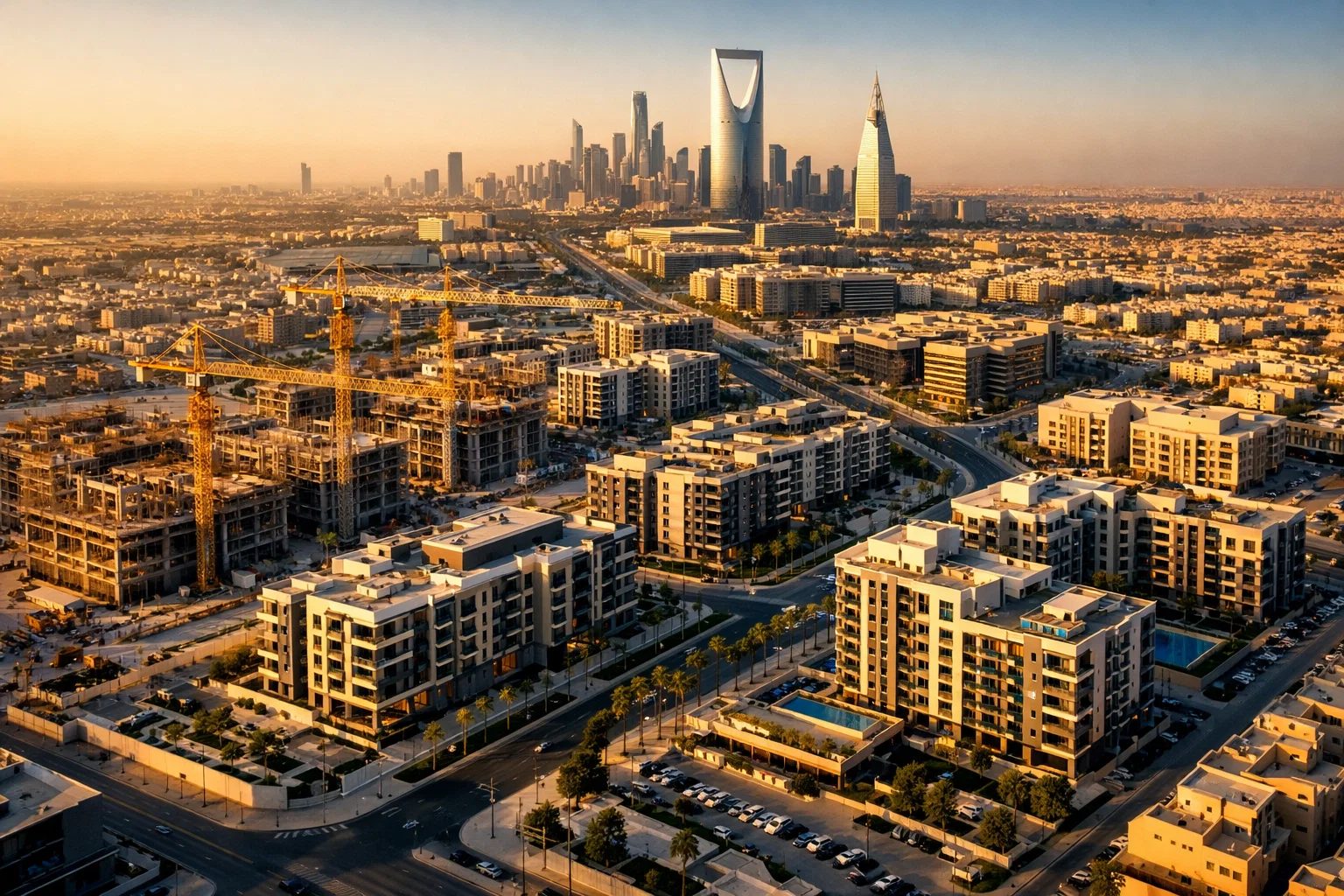
Quick Answer: What Is Real Estate Development?
Real estate development is the coordinated process of creating, improving or repositioning property so that it serves a viable use and creates long-term real estate value.
A development may involve vacant land, an existing building or an underutilized property.
The developer’s role is to connect the property, market, intended use and execution strategy so that the completed asset responds to actual demand.
What Does a Real Estate Developer Actually Do?
A real estate developer does more than supervise construction.
Depending on the opportunity, a developer may help determine:
- What use is appropriate for a property
- Who the future buyer, tenant or user will be
- Whether local demand supports the proposed concept
- How the site should be positioned
- Which specialists are required
- How the different development activities should be coordinated
- How the completed property will function in the market
This distinguishes a developer from a contractor.
A contractor is primarily responsible for carrying out construction work, while a developer coordinates the wider transformation of a site or property from opportunity to usable real estate asset.
How Does Property Development Create Value?
Development creates value when a property becomes more useful, better matched to demand or more suitable for its location.
Examples can include:
- Turning vacant land into housing that meets local demand
- Repositioning an outdated property for a more appropriate use
- Creating commercial property in an area with established business activity
- Developing a site to better use its accessibility and surrounding services
- Creating an integrated property that serves more than one user group
Construction itself does not guarantee value.
A technically well-built property can still struggle if the market does not need it, if the intended use is unsuitable for the location, or if the completed asset does not meet user expectations.
For this reason, development begins with understanding the market problem the property is intended to solve.
Real Estate Development in the Saudi Context
Property development in Saudi Arabia operates within a market that includes established residential and commercial sectors, major urban expansion and increasingly formalized real estate regulation and market information.
The Real Estate General Authority provides services and enquiries related to areas such as licensed real estate activities, off-plan projects, lease contracts and other regulated market functions.
This means developers should consider both:
market suitability
and
the regulatory environment relevant to the specific development model.
The exact requirements vary according to the property, project structure and activity involved, so detailed regulatory requirements should be verified through the relevant Saudi authorities rather than assumed from a general development guide.
Why Local Market Understanding Matters
Real estate is inherently local.
National growth does not mean every city, district or property type will perform in the same way.
Two locations in the same city can differ materially in:
- Target customers
- Land values
- Accessibility
- Surrounding services
- Existing property supply
- Commercial activity
- Residential preferences
- Future development potential
This makes local knowledge especially important in Riyadh, where different districts serve very different residential and commercial needs.
For a dedicated location analysis, see our guide to choosing a real estate project location in Riyadh. That page covers the location-selection intent in detail, so this guide intentionally does not repeat it.
What Makes a Development Concept Appropriate for a Site?
An appropriate development concept connects three things:
1. The Site
What can realistically be created on the property?
Important considerations may include the site’s physical characteristics, accessibility, surrounding uses and permitted development framework.
2. The Market
Who is expected to use, buy or lease the completed property?
The development concept should respond to identifiable demand rather than assumptions.
3. The End Use
How should the property function when it is completed?
A development designed for families has different requirements from one intended for offices, retail users or a mixed group of occupants.
The strongest concept is therefore not necessarily the largest project.
It is the concept that creates the best fit between site, demand and intended use.
Main Categories of Real Estate Development
Real estate development can be grouped into several broad categories.
Residential Development
Residential development includes property intended primarily for individuals and families, such as apartments, villas and residential communities.
Commercial Development
Commercial development can include offices, retail assets and other property designed around business activity.
Mixed-Use Development
Mixed-use projects combine more than one complementary property use within the same development.
Land Development
Land development focuses on preparing land for future property use or development.
These definitions are intentionally brief.
For detailed project categories, cost considerations and project-type comparisons, use the dedicated Real Estate Development Projects in Saudi Arabia guide.
That URL should own the development projects intent.
How Does a Real Estate Development Move From Idea to Asset?
At a high level, development generally moves from an opportunity to a completed property through a sequence such as:
Opportunity → Assessment → Development Concept → Planning → Execution → Completion → Use
The purpose of this guide is not to explain each stage in detail.
For the full workflow, feasibility, site assessment, approvals, execution and delivery stages, read the dedicated real estate development process in Saudi Arabia.
Keeping the detailed lifecycle on that page avoids confusing Google about which URL should rank for real estate development process searches.
How Should a Property Development Opportunity Be Evaluated?
Before substantial resources are committed, a development opportunity should answer a small number of fundamental questions.
Who Needs This Property?
A development requires an identifiable future user.
That could be:
- Residents
- Businesses
- Retailers
- Commercial tenants
- Property buyers
- Another defined user group
If the target user is unclear, the development concept may also be unclear
Why This Property or Site?
The site should provide a logical reason for the intended use.
That may relate to surrounding demand, accessibility, neighboring activities or another location-specific advantage.
What Problem Does the Development Solve?
Good real estate development responds to a practical market requirement.
Examples might include:
- Housing availability
- Suitable commercial space
- Better use of existing land
- Modern replacement of an outdated asset
- More efficient integration of different property uses
Will the Completed Asset Remain Useful?
Developers should think beyond construction completion.
A successful property ultimately has to function for its owners, occupants or users after delivery.
A Simple Real Estate Development Framework
A practical way to evaluate a property development opportunity is to answer five core questions before moving into detailed planning and execution.
| Question | Development Decision |
|---|---|
| Who is the user? | Defines the target market. |
| Why this site? | Tests location suitability. |
| What should be developed? | Defines the most appropriate property concept. |
| Why will the market need it? | Tests whether genuine demand exists. |
| How will the completed asset be used? | Tests long-term functionality and market relevance. |
This framework provides a high-level development decision model. For detailed feasibility, planning and execution stages, see the Real Estate Development Process in Saudi Arabia .
Developer, Investor and Contractor: What Is the Difference?
These roles are related but should not be treated as identical.
Real Estate Developer
The developer coordinates the transformation of a property or land opportunity into a functioning real estate asset.
Real Estate Investor
An investor provides or deploys capital with the objective of generating financial value from property.
An investor may acquire an already completed asset without participating in development.
Contractor
A contractor carries out defined construction works according to a project scope and technical requirements.
One organization may sometimes perform more than one role, but understanding the distinction helps clarify responsibilities within a development.
Real Estate Development vs Property Management
Development focuses on creating or transforming the asset.
Property management focuses on operating and maintaining a property after it is available for use.
Management can involve tenant coordination, occupancy, rent collection, maintenance and ongoing property operations.
Abdulmohsin Al Rossais & Sons Group Co. provides a separate Property Management Service for this post-development stage.
Separating these two activities is important because a completed development does not automatically manage itself effectively.
Why Development Decisions Should Be Evidence-Based
Assumptions can be expensive in real estate.
Developers should avoid relying solely on broad statements such as:
- “This city is growing.”
- “This district is popular.”
- “Residential property always performs well.”
- “Commercial assets generate higher returns.”
Instead, decisions should be based on relevant information for the specific location and property use.
Saudi Arabia’s official real estate ecosystem includes regulatory and enquiry services that can help users verify formal market information rather than relying entirely on informal assumptions.
This evidence-based approach is particularly useful for AI-search visibility as well because it gives Google, ChatGPT and other systems clear factual relationships between:
Saudi Arabia → real estate regulation → property development → local market analysis → developer decisions.
When Does a Landowner Need a Real Estate Developer?
A landowner may consider professional development support when a property has potential but there is uncertainty around questions such as:
- What use is most suitable?
- Who is the target customer?
- How should the site be positioned?
- How should the different project parties be coordinated?
- What development strategy best fits the property?
- How can the asset be prepared for long-term use?
This is where a developer’s role becomes different from simply hiring a construction contractor.
The developer helps connect the commercial purpose of the property with its development strategy.
Real Estate Development Experience in Riyadh
Abdulmohsin Al Rossais & Sons Group Co. operates across real estate development and related property activities in Riyadh.
The Group's portfolio includes different residential and commercial property formats, providing first-party examples of real estate development rather than relying only on theoretical market discussion.
Relevant developments include:
Explore the complete Al Rossais Projects Portfolio to view additional residential and commercial developments in Riyadh.
These completed and ongoing developments provide first-party evidence of Al Rossais' real estate development experience in Riyadh and strengthen the connection between the Group's market knowledge and practical project delivery.
Real Estate Development Services
Organizations or property owners seeking direct development support have a different intent from readers learning about development.
For that reason, the commercial information is kept on a separate page:
Real Estate Development Services by Abdulmohsin Al Rossais & Sons Group Co.
The service page describes the Group’s development offering and methodology, while this article remains educational.
This distinction protects both URLs from competing for the same search intent
Key Takeaway
Real estate development is not simply the act of constructing property.
It is the process of determining how a property can serve a real market need and then coordinating its transformation into a usable asset.
In Saudi Arabia, a strong development decision should connect:
Site + Market Demand + Appropriate Use + Execution + Long-Term Function
The most appropriate project is therefore not always the most ambitious one.
It is the project that creates the strongest relationship between the property, its location and the people or organizations expected to use it.
Frequently Asked Questions
Real estate development is the process of creating, improving or repositioning land or property for a defined use. It combines market understanding, property planning and coordinated project execution to produce a functioning real estate asset.
A developer determines how a property opportunity can be transformed into a viable asset and coordinates the parties and decisions required to achieve that outcome.
No. A contractor primarily performs construction work, while a developer coordinates the broader commercial and property-development strategy from opportunity through completion.
Development involves creating or materially transforming property. Investment can involve acquiring an existing asset for income or long-term financial value without developing it.
The broad categories include residential, commercial, mixed-use and land development. More specialized categories are explained in the separate real estate development projects guide
Development generally moves from opportunity assessment and concept definition through planning, execution and completion. The full stages are explained in the real estate development process guide
Market demand identifies whether there are enough suitable buyers, tenants or users for the proposed property. Without a clear target market, even a well-constructed development can struggle to perform.
Property demand, land values, accessibility and user preferences can vary considerably between Riyadh districts. Development decisions should therefore be based on the relevant location and property segment rather than broad assumptions about the whole city.