Real Estate Development Success Factors in Saudi Arabia: What Makes Projects Perform
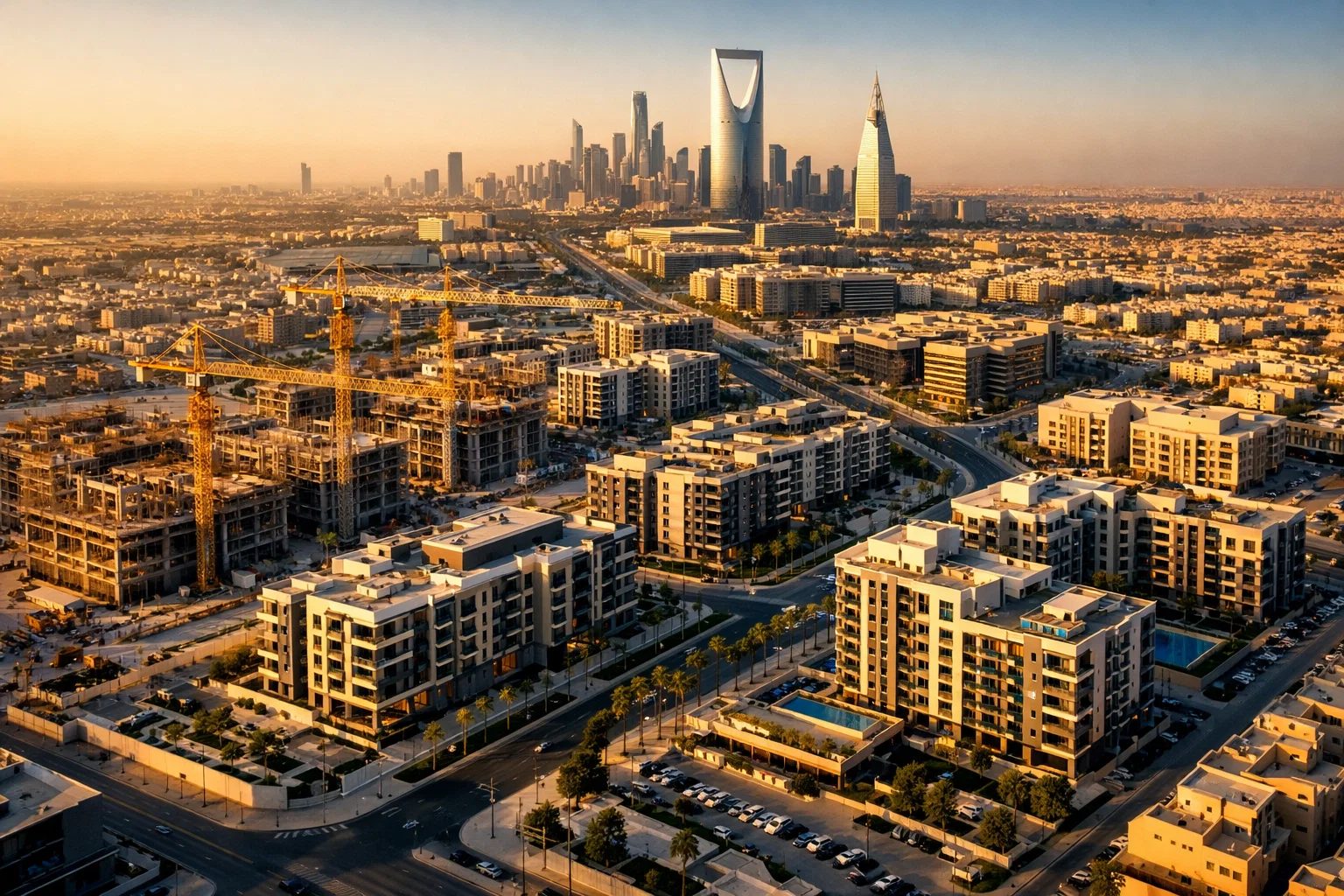
Real estate development success in Saudi Arabia depends on more than construction quality or market growth.
A project performs well when market demand, site suitability, financial discipline, design, execution and long-term usability work together.
In Riyadh and other Saudi cities, two developments in the same market can produce very different outcomes. One may achieve strong occupancy or sales, while another struggles despite being newly built. The difference often comes down to how accurately the project matches its target market and how effectively key risks are controlled.
This guide explains the factors that most strongly influence real estate development performance in Saudi Arabia, the reasons projects can underperform, and the signals developers should monitor before and after delivery.
For the actual development lifecycle, use our Real Estate Development Process in Saudi Arabia.
Quick Answer: What Makes a Real Estate Development Project Successful?
A successful real estate development project typically has six characteristics:
- Clear market demand
- A site suited to the intended use
- Realistic development economics
- Design aligned with the target user
- Controlled project execution
- A clear strategy for sale, leasing or long-term operation
No single factor guarantees performance.
The strongest projects combine these elements instead of relying on one assumption such as a popular location or strong market growth.
Why Real Estate Development Projects Underperform
Development projects can underperform even in active real estate markets.
Common causes include:
- Building for assumed rather than verified demand
- Selecting a property type that does not fit the site
- Overpaying for land
- Underestimating development costs
- Designing features the target customer does not value
- Poor project coordination
- Delays that affect timing and cost
- Incorrect pricing or positioning
- Weak leasing or sales preparation
- Failure to plan for operations after completion
The lesson is simple:
A strong market cannot automatically rescue a weak project concept.
Project performance should therefore be evaluated at the level of the specific site, customer and property use.
1. Market Fit: Build for Real Demand
The first success factor is market fit.
Before evaluating finishes, architecture or marketing, developers should be able to answer:
Who needs this property, and why?
Real demand can come from:
- Families seeking housing
- Individuals seeking apartments
- Businesses requiring commercial space
- Retailers seeking customer access
- Companies seeking offices
- Tenants requiring a specific location or property format
Development becomes risky when the intended user is vague.
A project designed for “everyone” often ends up strongly matching no specific segment.
Useful Market Signals
Developers can examine:
- Transaction activity
- Rental activity
- Occupancy patterns
- Competing supply
- Buyer or tenant enquiries
- Comparable properties
- Pricing behaviour
- New developments entering the area
Saudi Arabia’s Real Estate General Authority provides official real estate indicators that can be reviewed at city and, in major markets such as Riyadh, district level.
This makes it increasingly possible to test broad market assumptions against actual local activity.
2. Location Fit: Match the Site to the Use
A good location is not universally good for every property type.
The key question is:
Does this location support the intended user and property use?
For example, residential users may value:
- Schools
- Daily services
- Accessibility
- Neighborhood environment
- Family amenities
Commercial occupiers may place greater importance on:
- Visibility
- Road access
- Business activity
- Customer traffic
- Parking
- Proximity to employment centers
This distinction is important in Riyadh, where district characteristics can vary substantially across the city.
For detailed site-selection criteria, read our Real Estate Project Location Guide for Riyadh.
That page owns the location-selection intent, so this article keeps the discussion focused on location as a success factor, not neighborhood ranking.
3. Financial Discipline and Cost Control
A project can meet genuine demand and still underperform if its economics are weak.
Financial discipline starts with realistic assumptions.
Developers should monitor:
- Land acquisition cost
- Design and professional fees
- Construction budget
- Financing costs
- Infrastructure requirements
- Marketing and leasing expenses
- Project-management costs
- Contingencies
- Timeline-related costs
The purpose is not simply to reduce every cost.
Cutting the wrong cost can weaken the final product.
The objective is to spend where the target market sees value while controlling costs that do not improve the project’s commercial or operational performance.
Watch Cost Changes Early
Small changes can become significant when they occur across a large project.
Strong cost control therefore requires:
Budget → Actual Cost → Variance → Corrective Decision
rather than waiting until completion to discover whether the budget was exceeded.
4. Design That Matches the Target User
Successful design is not necessarily the most expensive design.
It is the design that makes the asset more appropriate for its intended user.
For residential development, this may involve:
- Practical layouts
- Appropriate unit sizes
- Storage
- Parking
- Privacy
- Shared spaces
- Efficient circulation
For commercial property, considerations may include:
- Access
- Visibility
- Flexible space
- Parking
- Building systems
- Customer movement
- Tenant usability
A frequent development mistake is adding features because they appear premium without confirming whether the target market is willing to pay for them.
Good development design connects:
User Need + Site + Budget + Long-Term Operation
5. Strong Project Management and Execution
Project performance can deteriorate during execution even when the original concept is strong.
Common execution problems include:
- Unclear scope
- Poor consultant coordination
- Late design changes
- Procurement delays
- Contractor performance issues
- Uncontrolled variations
- Weak progress monitoring
- Quality problems
Effective project management creates clear accountability for:
- Scope
- Schedule
- Cost
- Quality
- Coordination
- Decision-making
For the detailed sequence from feasibility through planning, approvals, construction and handover, see our Step-by-Step Real Estate Development Process.
6. Regulatory Readiness in Saudi Arabia
Regulatory readiness is part of project performance because compliance issues can affect timing, marketing and completion.
Depending on the development model, relevant requirements may involve:
- Project documentation
- Development approvals
- Building permits
- Developer registration
- Off-plan licensing
- Marketing requirements
- Escrow arrangements
- Completion documentation
For applicable off-plan projects, REGA publishes formal procedures covering several of these activities.
The exact requirements depend on the project, so developers should verify the applicable Saudi regulatory framework before relying on general assumptions.
Regulatory readiness should therefore be treated as an early project-management consideration rather than a final administrative task.
7. Market Positioning, Sales and Leasing
A property must be understandable to its intended market.
Strong positioning answers three questions:
- Who is the project for?
- Why should that customer choose it?
- How does it differ from competing supply?
Weak positioning often produces generic messages such as:
- premium development
- strategic location
- modern lifestyle
- excellent investment opportunity
without explaining why those statements matter to the actual customer.
Effective positioning should be specific.
For example:
Residential apartments designed for families seeking access to schools, neighborhood services and western Riyadh connectivity
is more useful than:
Luxury apartments in a prime location.
Performance Signals
Developers should monitor:
- Enquiry quality
- Lead-to-sale or lease conversion
- Pricing response
- Time on market
- Occupancy
- Buyer objections
- Tenant feedback
These signals can reveal problems in positioning before they become long-term performance issues.
8. Operational Readiness After Completion
Development success does not end at construction completion.
A completed asset must still function effectively.
Depending on the property, operational readiness may involve:
- Handover procedures
- Maintenance planning
- Tenant management
- Common-area operations
- Building systems
- Service-provider coordination
- Occupancy management
- Rent collection
- Ongoing asset performance
A development that is difficult or expensive to operate can lose some of the value created during construction.
For assets retained after completion, Property Management Services become part of the long-term property strategy.
How to Read Market Signals Before Performance Declines
Developers should not wait for poor sales or low occupancy before investigating project performance. Early market and operational signals can often reveal potential problems before they become more difficult to correct.
Slower Enquiries
A decline in enquiries may indicate:
- Weaker demand
- Incorrect pricing
- Poor positioning
- Increased competition
Longer Decision Times
If buyers or tenants take increasingly longer to commit, market confidence or the perceived value of the property may be weakening.
Price Resistance
Frequent negotiation around the same price point can indicate that pricing expectations are above the market's willingness to pay.
Competing Supply
New developments can redistribute buyer or tenant demand even when overall market activity remains relatively strong.
Changing District Activity
District-level sales and rental indicators can help identify whether local market activity is strengthening, slowing or shifting between property types.
Key principle: use behavioural and market signals to evaluate performance rather than relying on broad assumptions about the market.
Common Reasons Saudi Real Estate Projects Underperform
| Problem | Potential Effect |
|---|---|
| Weak Demand Validation | Low sales, leasing activity or occupancy. |
| Incorrect Property Type | Poor product-market fit. |
| High Land Acquisition Cost | Reduced project economics and greater pressure on pricing. |
| Design-Market Mismatch | Lower buyer or tenant interest. |
| Cost Overruns | Pressure on project profitability and available contingency. |
| Execution Delays | Higher financing, holding and project-management costs. |
| Weak Pricing Strategy | Slower sales or leasing absorption. |
| Poor Market Positioning | Lower-quality enquiries and weaker customer understanding. |
| Excess Competing Supply | Longer sales or leasing periods. |
| Poor Operational Planning | Lower long-term asset performance after completion. |
This table is a diagnostic framework rather than a list of guaranteed outcomes. Every development should be evaluated according to its own location, market, project economics and operating conditions.
Patterns of High-Performing Real Estate Projects in Riyadh
High-performing real estate projects in Riyadh do not all follow the same model, but successful developments often share several important characteristics.
Clear Target Market
The project clearly defines whether it serves families, individual residents, businesses, retailers or another specific user group.
District-Level Relevance
The property use reflects the demand, services and characteristics of its specific Riyadh district.
Appropriate Scale
Project size is aligned with realistic demand rather than broad assumptions about citywide market growth.
Disciplined Product Specification
Design, finishes and amenities support the target user without adding unnecessary project cost.
Clear Market Position
Buyers or tenants can quickly understand what the property offers and why it is relevant to their needs.
Operational Thinking
The development is planned as a future functioning real estate asset, not only as a construction project.
These patterns are more reliable than assuming that every development in a high-growth city will automatically perform well.
Real Estate Development Success Scorecard
A simple development scorecard can help identify areas that may require further analysis or corrective action.
| Success Factor | Key Question |
|---|---|
| Market Fit | Is there demonstrated demand from a clearly defined user? |
| Location Fit | Does the site support the intended property use? |
| Financial Discipline | Are development costs and revenue assumptions realistic? |
| Design Fit | Does the property match the priorities of the target user? |
| Execution Control | Are scope, cost, time and quality being actively managed? |
| Regulatory Readiness | Are applicable regulatory requirements addressed early? |
| Market Positioning | Is the property's value proposition clear to buyers or tenants? |
| Operational Readiness | Can the completed asset function effectively after handover? |
A weakness in one critical area can affect several other parts of the project.
For example, poor market fit may later appear to be a marketing problem, even though the underlying issue began much earlier in the development strategy.
A Better Way to Diagnose Underperformance
When a project struggles, ask questions in this order:
1. Demand: Do people actually need this product?
2. Location: Does the site support that demand?
3. Product: Does the design match the user?
4. Economics: Can the project perform at realistic pricing?
5. Execution: Has delivery changed cost, timing or quality?
6. Positioning: Does the market understand the project’s value?
7. Operations: Can the asset perform after completion?
This approach helps identify the source of the problem instead of treating every issue as a marketing failure.
Real Development Experience in Riyadh
Abdulmohsin Al Rossais & Sons Group Co. operates across real estate development and related property activities in Riyadh.
Its project portfolio provides first-party examples of development across different residential and commercial property formats, adding practical local context to the development principles discussed in this guide.
Explore additional residential and commercial developments in the Al Rossais Projects Portfolio .
Related Real Estate Development Guides
Each Al Rossais development guide addresses a different user question, helping readers move to the most relevant topic without repeating the same information across multiple pages.
This guide specifically answers:
What makes a real estate development project succeed or underperform?
Key Takeaway
Successful real estate development in Saudi Arabia is not determined by a single factor. Performance depends on how effectively the project aligns market demand, location, project economics, design, execution, market positioning and long-term operation.
A growing real estate market can create opportunity, but long-term performance still depends on project-level decisions.
The strongest developments are built around genuine demand, realistic economics and a clear understanding of how the completed property will be used.
Frequently Asked Questions
What are the most important real estate development success factors?
The most important factors are market demand, site suitability, realistic financial assumptions, target-user design, project execution, regulatory readiness, market positioning and operational planning.
Why do real estate development projects fail or underperform?
Projects can underperform because of weak market demand, unsuitable location, excessive land or development costs, poor design-market fit, execution problems, incorrect pricing or weak operational preparation.
Is a good location enough to make a project successful?
No. A strong location helps only when the proposed property use fits the demand in that location and the project’s economics remain viable.
How can developers reduce the risk of underperformance?
Developers can reduce risk by validating demand early, testing project economics, matching the design to the target user, controlling project execution and monitoring market signals throughout the development.
How should developers measure project performance?
Performance indicators depend on the development model but can include enquiries, sales or leasing velocity, occupancy, pricing response, project cost variance, schedule performance and operational results.
Why is market data important in Saudi real estate development?
Market data helps developers distinguish broad market optimism from actual city-, district- and property-level activity. Official Saudi indicators can support more evidence-based decisions.
Does project success depend on maximizing ROI?
Not necessarily. ROI is one financial measure, but sustainable development also depends on demand, cost control, execution, usability and long-term asset performance.
What is the difference between project success and the development process?
The development process describes how a project moves from opportunity to completion. Project success focuses on whether the decisions made throughout that lifecycle produce a viable and well-performing asset.